


Through the support of the German Government through KfW Development bank, the ILO EIIP and the Ministry of Agriculture’s Green Plan are advancing climate-resilient agricultural infrastructure and creating jobs and inclusive livelihood opportunities for vulnerable farming communities across Lebanon.
BEIRUT (ILO News) – As Lebanon continues to face the compounded impacts of climate change, economic and political crises, and growing pressures on rural livelihoods, the “Greening the Lands” initiative contributes to resilient and inclusive rural recovery pathways across the country. Implemented through the partnership between the International Labour Organization’s Employment-Intensive Infrastructure Programme (EIIP) and the Ministry of Agriculture’s Green Plan (GP), with funding from the German Government through KfW Development Bank, the initiative combines sustainable agricultural rehabilitation with employment-intensive and locally driven approaches to support vulnerable rural communities across Lebanon.
By rehabilitating agricultural lands and restoring critical rural infrastructure, the initiative supports vulnerable farmers while generating short-term employment opportunities under decent working conditions. Integrating climate adaptation measures with employment-intensive methodologies, the intervention contributes to restoring agricultural productivity, improving water management, combating land degradation, and strengthening the resilience of communities affected by overlapping economic, environmental, and social challenges.
Operating across eight regions and 20 clusters throughout Lebanon, the programme has generated measurable environmental, social, and economic impact. Since 2022, more than 892,250 square meters of agricultural land have been rehabilitated, 962 concrete water reservoirs constructed, over 93,000 square meters of retaining walls installed, and more than 20,500 meters of rockery fences completed to support soil stabilization and sustainable land management.
At the same time, the initiative has generated significant decent work opportunities through labour-intensive approaches that prioritize local communities and vulnerable groups. To date, the programme has created more than 212,000 worker days and engaged over 4,300 workers across Lebanon. The intervention further promotes social inclusion through the participation of women and persons with disabilities within project implementation, contributing to more equitable access to livelihood opportunities.
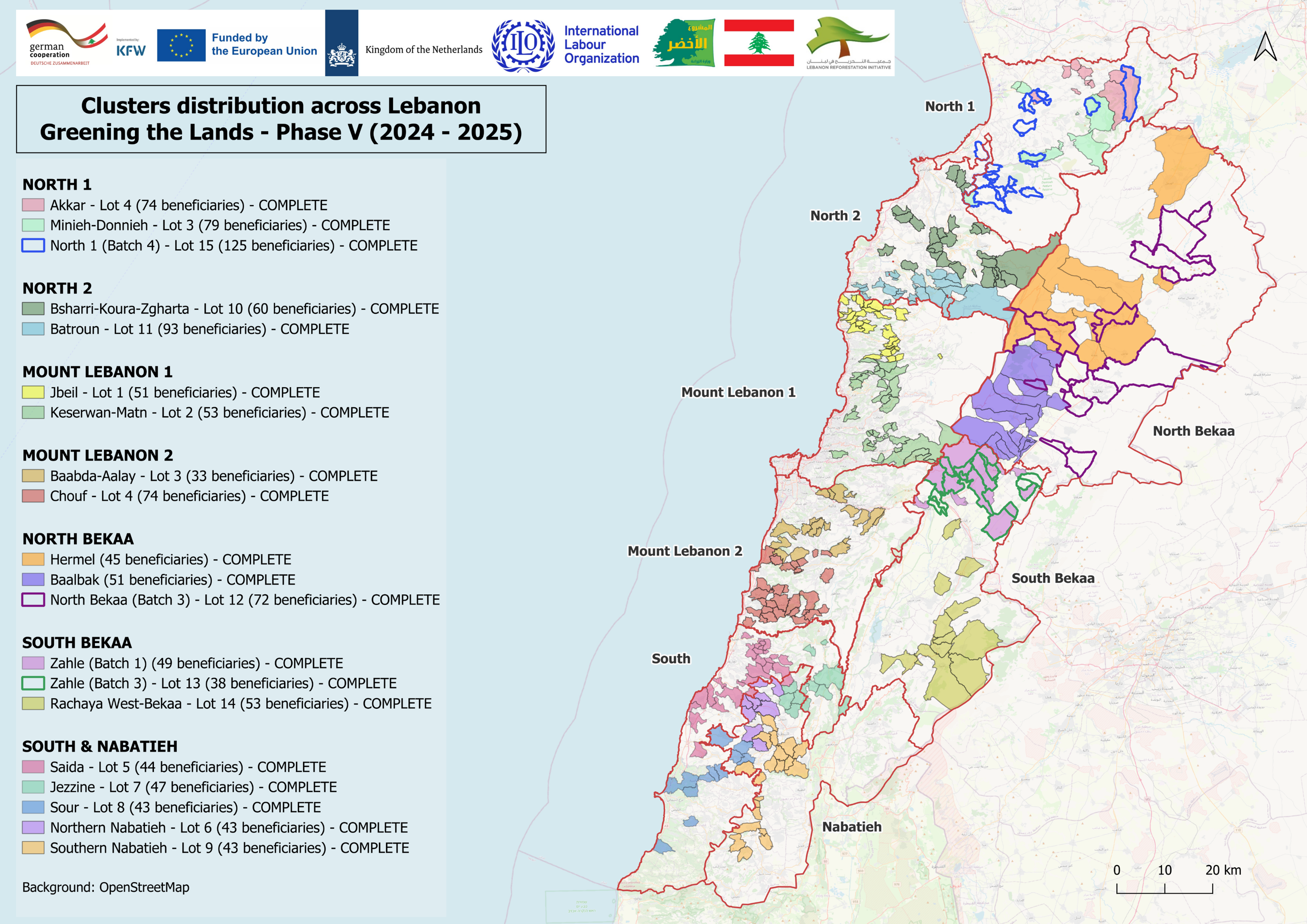
By October 2025, more than 1,800 farms had benefited from rehabilitation works under the programme, while Phase VI aims to support an additional 425 farms and generate nearly 50,000 workdays nationwide, further expanding the programme’s socio-economic and environmental impact.
A central component of the initiative is the application of Local Resource-Based Technology (LRBT), an employment-intensive methodology that prioritizes local labour, locally available materials, and cost-effective implementation approaches. This model contributes not only to job creation and local economic stimulation, but also to strengthened community ownership, sustainability of interventions, reduced environmental footprint, and enhanced resilience of local supply chains.
The programme further emphasizes decentralized coordination, transparency, and robust field-level monitoring to ensure technical quality, compliance with decent work principles, and alignment with environmental and social standards. Joint supervision conducted by the Green Plan, the Lebanon Reforestation Initiative (LRI), and ILO field teams supports quality assurance, accountability, and efficient implementation throughout project execution.
Despite ongoing challenges linked to climate variability, political instability, regional conflicts, and the impacts of the 2024 war, the “Greening the Lands” initiative continues to demonstrate how sustainable public infrastructure interventions can simultaneously advance climate resilience, decent work, local economic recovery, and inclusive development outcomes.


.svg)
